Tuesday, November 25, 2008

Editorial Final Drafts are due 12/15(A) 12/16(B)

For the next two weeks, we will be working on revising our Editorials. While revising your Editorial, you should think about the writing lessons we have already had: Leads for an Essay, SEEPS Elaboration, Conclusions, Organizing your Editorial, Citing Sources, and Formatting your Editorial. Don't forget to use your rubric as a guide. Remember they must be typed (12 pt, Times New Roman font, double spaced). We can't wait to read your revised work! Below are the requirements for a top score (from the rubric).
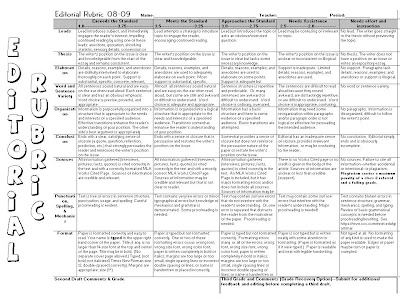
Lead introduces subject, and immediately engages the reader’s interest, impelling continued reading by using one of these leads: anecdote, quotation, quicklist, shocking statistic, sensory details, or concession.

The thesis skillfully and clearly presents the writer's claim, and the reasons in the best order.

Details, reasons, examples, and anecdotes are skillfully intertwined to elaborate thoroughly on each point. Support is substantial, specific, concrete, relevant, and/or illustrative.

All sentences sound natural and are easy-on-the-ear when read aloud. Each sentence is clear and has an obvious emphasis. Word choice is precise, powerful, and appropriate.

Information is purposefully organized into a structure that is appropriate to the needs and interests of a specified audience. Effective transitions enhance the reader's understanding of your position. The other side's best argument is appropriately acknowledged and then refuted.

Ends with a clear, satisfying sense of closure (a quote, question, reflection, prediction, etc.) that strongly persuades the reader and reinforces the writer's position on the issue.

All information gathered (interviews, pictures, facts, quotes) is cited correctly in the text and with a correctly formatted MLA Works Cited Page. Sources of information are credible and relevant.

Text is free of errors in sentence structure, punctuation, usage, and spelling. Careful proofreading is evident.

Paper is formatted correctly and easy to read. Your name is typed in the upper right hand corner of the paper. Title, if any, is no larger than 14-size font at the top and center of the page. Title may be in bold. (No separate cover page allowed.) Typed, (not bold, not italicized) Times New Roman size 12, double-spaced (correctly). Margins are appropriate: size (1”).

Thursday, October 30, 2008

Digital Sticky Note: Literary Luminary--Due before November 12, 9 PM

We have just assigned our first digital sticky note assignment.

The Duval County Technology Standards require that : Students use telecommunications to collaborate, publish, and interact with peers, experts, and other audiences. and students use a variety of media and formats to communicate information and ideas effectively to multiple audiences.

So, we're starting with something small: one response, identifying and explaining the effectiveness of a literary technique in the book you are currently reading. Here are the directions we shared in class:


1. Read your book and find an example of a literary technique. (You can still use an actual sticky note for this part.)
2. In a Word document (or any word processing program), type your title, author, and page number. Then, type the passage and response. Use your spell check tool and review your work for content errors.
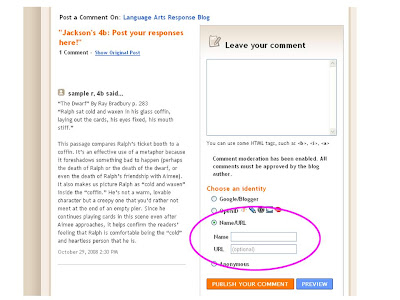
3. Go to the response blog: izzojacksonresponses.blogspot.com. Then, select the response post for your class. Click on the “comments” link.
4. Paste your passage and response in the box.
5. Under the “choose an identity” heading, select the Name/URL button. Enter your first name, last initial, and class period. Ex: Bethany T, 1A
6. Then, click the orange “publish your comment” button.


Your response will then be saved (but not visible on the blog) until one of the ELA teachers "approves" it and publishes it. Most responses will be published within 24 hours. You will receive your grade later in class. You will be graded on
  • the insightfulness of your response,
  • the accuracy of the literary technique you've identified,
  • mechanical correctness/spelling (proofreading), and
  • correctly formatting your response.


If you do not have access to the internet or to a computer, please see your teacher for a pass to use one of our computers in the morning or you may stay after on Monday, November 3rd to use a computer. Some class time will be offered for completing the response as well.

We look forward to reading our first paperless assignment!

Thursday, October 16, 2008

Character Analyst is due on 10/22(B) and 10/23 (A)

Directions for Character Analyst
Your job is to pay attention to how the writer develops character.
Find three different passages (one per sticky) that reveal three of these methods of characterization:
•what the character says about him/herself,
•what the character's actions and choices tell you,
•what other characters say about him/her, OR
•what the author tells us directly about the character’s personality.
Then, explain what conclusions you make about the character’s personality from the passage. Make sure you identify a personality trait and explain why it's important to know that your character has that particular trait.

For a complete assignment, you will need to have 6 notes: 3 character analyst notes, 1 word wizard, 1 connection, and 1 summary. You also need to read 50-150 pages and 90 minutes.

SAMPLES

Thursday, October 9, 2008

Progress Reports are going home Thursday, 10/9 and Friday, 10/10

Progress Reports
To update students and parents, we are sending progress reports home this week. We're nearing the end of the quarter, but there are still three grades that can help improve your final average: SN#3 (Questioner), Sourcebook Check, and Book Card Check. Students who are missing work will need to turn in the late work and conference with us before Tuesday, October 21. Morning and afternoon conferences are scheduled by appointment.

Wednesday, October 8, 2008

Jackson's 4b--A picture


Thursday, October 2, 2008

Questioner Sticky Notes Set (SNS #3) --due 10/9 and 10/10

Your job is to write and answer THREE questions, using the QAR strategy, that would promote discussion. TAS—Think and Search. This is a question that requires the reader to search for evidence throughout the reading passage or book. Question stem: What evidence (or clues) do we have that...? To answer the question, you need three examples (at least one must be a quote). AAM—Author and Me. This question requires you to read the text and form opinions, make inferences and connections, or predict events based on evidence. The reader can answer the question with ideas derived from the book (AUTHOR), but must also use his own knowledge and experience (ME). In your answer, you must use at least one quote from the text. Note: Do not ask the author the question. OMO--On My Own. The reader is inspired to ask a question about a theme or issue. The reader can answer the question without reading or rereading the text. In fact, anyone could answer the question, even without reading the passage or book. However, the book inspires you to wonder about this issue. Answer the question first, then explain how the book/passage made you wonder about this issue. You may use a quote to show what inspired your thoughts. Note: There should not be any character names mentioned in an OMO question.

Thursday, September 18, 2008

SN#2 (Visualizer) is due on 9/25 (A) & 9/26 (B)


VISUALIZER DIRECTIONS:
Your job is to select a passage from the text that is full of details that paint a picture in your mind. Then, create a visual representation that illustrates specific details of the quote. It should be obvious to the “viewer” how the picture relates to the quote. If necessary, you may add words to the picture to help others understand it. The picture must have color.
Then, write a response that answers one or two of these questions: How is this passage important to the text? What real place or person did you picture while sketching? Why did you choose this scene to illustrate? Why did you choose to draw it the way you did? What parts were difficult to capture in your drawing? What did drawing it help you see differently? Who would you cast in the roles if this were turned into a movie? Why? (This could be famous people or classmates.) How would you design the set and lighting if this were a play? Explain your plan.
Don't forget you need to read at least 50-150 pages and record an hour and a half of reading. Use the bookmark on the back of the rubric to document your reading.
This assignment is due next week: 9/25 (A) and 9/26 (B)

Monday, September 8, 2008

Sticky Note Assignment #1 (Conflict Catcher) Due on 9/15 (A) and 9/16 (B)

It's homework time! In class, we've practiced several reading strategies: connection, word wizard, summary, and conflict. Now, it's your turn to try these strategies on your own, with your own reading. Remember you will turn in six total sticky notes: 3 conflict catcher notes, 1 connection, 1 word wizard, and 1 summary note.


In case you forget the requirements for any of the strategies, we've listed them below. For an extra copy of the rubric/bookmark, visit the handout bin in the classroom. Eventually, we'll make copies available to print at home.


CONFLICT CATCHER
Your job is to identify THREE types of conflict from the story or novel.
For each note, copy the passage that reveals the type of conflict:
human vs. human, human vs. self, human vs. society, OR human vs. nature.
Then, for each note, explain how the passage reveals the type of conflict. You must identify one of the conflicts as the main conflict of the story or novel and explain how this conflict drives the plot.
Your explanation and the support for your explanation must be detailed and must refer to the passage.


WORD WIZARD
Everyone’s job is to find one new or interesting word from your book. First, copy the sentence from which the word was found, and underline the word. Then, copy the definition from a dictionary (online or regular).
Want to go above and beyond? You could also include
-The word’s origin, or the stems/roots/prefixes/suffixes that make up the word.

-Other words that connect to that word because of meaning, sound, or common roots.

-Context clues that helped you figure out the meaning.
-What you thought the word meant before looking it up.
-How the word connects to the writer’s style.


CONNECTION

Each reader will make one connection between the book and our world.
Text to text: Compare the text to another book or even another kind of text like a movie or TV show. You must explain the connection and then explain how the connection has deepened your understanding of the text or enhanced your reading in some way.
Text to world: Compare the text to something happening in the world: a historical event, a current event, or an issue that affects society and the world community. Explain the connection and what you know about the event and then explain how the connection helps you better understand the book or the world event/issue.
Text to self: Compare a character in the book to yourself or compare an event in the book to something that has happened to you or someone you know personally. It may help to think about a time you have had similar feelings to the character or been in a similar situation. Explain the connection and then explain how the connection has deepened your understanding of the text or enhanced your reading in some way.

Wednesday, September 3, 2008

One Life, Six Words--What's yours?


Recently, we've been writing six word memoirs to decorate our folders. The folders will become a reading/writing portfolio where we'll keep all graded work. We love what you've come up with so far.
Want to share your memoir?
Post a comment (don't forget to use first name and last initial only).
Here are our examples:
Fear change, love change, always changing.
~Mrs. Izzo
Attempted normal life, still got surprises.
~Mrs. Jackson

Monday, August 18, 2008

The Bradbury Letter

Eighth graders in the Advanced and Gifted Language Arts classes at LaVilla will study the short stories and novels of the celebrated American writer, Ray Bradbury (1920- ). His writing style, advanced vocabulary, and original ideas challenge our students and inspire engaging classroom discussions.
In the next few weeks, your student will have the choice of one of Bradbury’s novels to read as part of our author study. Students will read the books in preparation for regularly scheduled small group discussions with students who have chosen the same book. The eighth grade teachers will lead whole class discussions of his work and we will facilitate discussion of particular issues in the small groups. The three books from which students may choose are listed below.

· Dandelion Wine, published in 1947. Short interconnected stories that reflect Bradbury’s all-American childhood growing up in Illinois. (ISBN #0553277537)
· Fahrenheit 451, published in 1953. A novel, now considered to be a classic, which presents a futuristic world in which firemen burn books instead of putting out fires. (ISBN# 0345342968)
· The Martian Chronicles, published in 1950. A series of stories exploring the possibilities and problems with a future colonization of Mars. (ISBN# 0553278223)

We are requesting your permission for your student to read one (or all) of these books. Although written in the 1950’s, the issues Bradbury explores include censorship, racism, the dangers of technology, and end of life as we know it. He uses some mature language to realistically explore these themes and acknowledge the presence of these issues in our society. These books are all in circulation in middle school media centers and at the public library. Any member of the 8th grade Language Arts team would be happy to discuss the books with you. We can also discuss which book would be most appropriate for your child. In fact, some of the titles are suitable for classroom use even without parental permission.
Finally, it would be helpful if each student purchases his/her own copy of the book, once assigned. Because we don’t have enough books for every child to check one out and read at home, we usually share and rotate books between classes so that each student has access to the texts during the school day. Having his/her own copy of the books makes it easier to keep up with the assigned reading and allows students to make notes directly on the pages of his/her book.
This author study has been challenging and popular with our students in the past. We are excited to begin this year. Thank you for the opportunity to read and learn with your students.


Please check one of the boxes below and return this portion by Thursday, August 28th (A day classes) or Friday, August 29th (B day classes). A copy of this letter is available at www.lavilla8ela.blogspot.com.
____ My child may read the books for the Ray Bradbury author study.

____ I’d like to discuss the options available for my child. Please contact me by phone number or e-mail: __________________________________________.

Please Print:
Student Name: _______________________

Parent/Guardian Name: ______________________________


Parent/Guardian Signature: ______________________________________