Friday, September 27, 2013

Peer Persuasion: What are you teaching the world?

We have embarked upon the early brainstorming for our persuasive writing unit.  It is called "Peer Persuasion."  We've been exploring different topics that can make the world safer and cleaner as well as topics that can help young people be more successful, healthier, or happier.  Students have finally narrowed down the choices and submitted sample thesis statements for their essays. 
In this post, we'll review some of the notes and requirements for this step of the persuasive essay process.


The thesis clearly presents the writer’s position.

The writer

uses three or more relevant facts/reasons to support the thesis.

demonstrates an understanding of the opposing side’s point of view (counter-argument) and respectfully shows why it’s wrong.

understands the intended audience and tailors the presentation accordingly.

The information is presented in a logical, easy-to-follow sequence.

Next, we wrote and turned in our thesis statements for our potential topics.  Most students will get to write about their first choice.  If you were absent, or didn't finish, please write three possible thesis statements and turn them in to your teacher.  See directions and notes below.
 
Your thesis statement(s) will tell the audience:

your claim, opinion, or what you want them to do or believe

a preview of the reasons/evidence that support this claim

the order in which you will be presenting your reasons and evidence with parallel structure.

Monday, August 12, 2013

Supplies for Language Arts and Reading Enrichment classes--Jackson, Salzer, & Schoof


Many of you, or your parents, are ready to hit the stores and get your school supplies.  
  1. Composition book. (*You'll need a separate comp book for enrichment 1, 2, or 3).
  2. Pens and Pencils for writing.
  3. A folder to take home assignments. (This may be part of another system, like an expandable binder.  This will STAY with you when you go home.)
  4. Notebook paper and printer paper.
  5. 3x3 Sticky notes.
  6. A jump or thumb drive for saving typed assignments.
  7. A reading book of your own choice.
  8. For advanced and gifted classes: your own copy of Fahrenheit 451 by Ray Bradbury.  This book is available at Amazon.com for about 7.00.  It will also be available through Scholastic Book Clubs if you'd prefer to wait.  We'll begin reading it as a class after winter break.
*Although the enrichment classes are separate classes, students will generally be able to use the same supplies, with the exception of a composition book.   You need one per class.

Students will also need access to a dictionary--print or online--at home. 

The 8th grade team also loves donations of items we frequently purchase ourselves.  Please choose one or two items to donate if your budget allows.
   
  • Tissues
  • Paper Towels
  • Lysol Wipes
  • Lysol Aerosol Spray or Magic Erasers (both remove desk graffiti)
  • 3x3 Post-It Notes
  • Scotch brand  Tape--especially precut slices or desktop dispensers
  • Dry Erase Markers
  • Hand Sanitizer or soap
  • White Printer Paper

Friday, May 17, 2013

Miss the Bradbury video?

In class, we've been filling out our Know-Wonder-Learn charts about Ray Bradbury.  If you were absent, or need a refresher, view it here and update the "Learned" column of the KWL chart.
Here's the link to the long version (22 minutes).

Friday, May 3, 2013

Last Batch of Word Roots

We've reached our last batch of word roots.  We'll follow the same process of brainstorming words together in class, and drawing symbols and clues to help us remember the meanings.  We'll have a quiz on these words on May 9th and 10th, following our regular pattern.
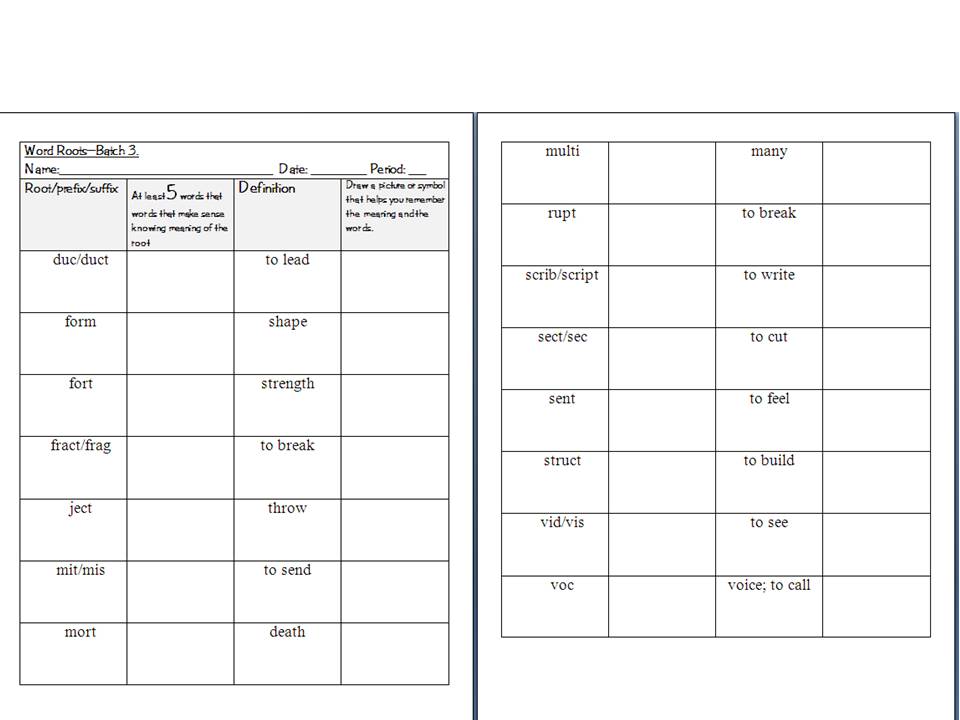
You can get a full size copy of the sheet, in case you've lost yours, by clicking here:


Wednesday, April 17, 2013

Analyzing Poetry with TPCASTT

It's testing time but as we emerge from FCAT, you'll have some homework due...a TPCASTT analysis on one of the poems we'll assign.  This will also help you study for the poetry quiz.

TPCASTT is an analysis that is well known and used throughout high school.  It is simply a series of steps to follow when you analyze a poem.  You can download one version of the TPCASTT by clicking here.  We've also included the steps below.  Please use complete sentences to answer the questions.  Refer to specific lines or quotes from the text to SHOW that you understand the poem and the literary techniques.

Depending on which teacher you have, you'll have a different selection of poems.  Some are from the textbook and some are found online.  You should choose the poem from your teacher's list that gives you the best opportunity to show what you know about analyzing poetry.

The poems are due at the time of the quiz since this homework is designed to prepare you for the quiz.  We'll update you about the date of the quiz once testing is finished.  Currently, B day classes will take the quiz on April 25th and A day classes will take the test on April 26th.  

Here are the choices:
For Jackson’s classes:  
On Turning Ten by Billy Collins
The Summer Day by Mary Oliver
The End of April by Phillis Larkin
Dusting by Julia Alzarez (textbook)
How Things Work by Gary Soto (textbook)
Quilting by Lucille Clifton (textbook)

Salzer’s classes—all from the textbook (online here)
My Father and the Figtree p 391-392
My Mother Pieced Quilts
Boots of Spanish Leather
Identity
We Alone
Willow and Gingkgo

For Schoof’s classes:
Sifter by Naomi Shihab Nye 
Sea Lullaby by Elinor Wylie  
The lesson of the moth by Don Marquis (textbook)


Title: What do you think this poem will be about before reading it?

Paraphrase: Before you begin thinking about meaning or tying to analyze the poem, don't overlook the literal meaning of the poem.   What actually happens in the poem?
List any words that you don’t know.  

Connotation/Craft:
If the poem is not literal, what else could it mean?
Which literary techniques are used?
How do they contribute to the overall meaning or the poem?
* imagery,
*figurative language (simile, metaphor, personification, symbolism, etc),
*word choice, syntax, and format,
*point of view,
*sound devices  (alliteration, onomatopoeia, rhythm, and rhyme).
You don’t need to identify all the techniques. The ones you do identify should  support the conclusions you have drawn.

Attitude--Who is the speaker?
What is the speaker talking about?
What is the speaker’s attitude toward that subject?

Shift--What are the shifts or changes in speaker or attitude? Look for key words (but, yet, however, although), time change, punctuation,   or format.

Title revisited--Now look at the title again.  Does the title have any new significance now?  Explain.

Theme--What is the lesson or message of the poem?  (One sentence)

Thursday, January 17, 2013

Keeping up with Bradbury


The advanced and gifted classes are reading Fahrenheit 451 in class.  If you miss a day, or need to re-read, here's a link to an online version that you can use: Fahrenheit 451.

If you need another copy of the discussion sheet, you can download it by clicking here.

Thursday, January 3, 2013

New Year....new roots....New QUIZ!

We're on to the new year with a new batch of word roots.  We are still rounding out the 2nd quarter though so this grade will be one of the last for this quarter.  You got your four-column notes to study and fill out during your first day back from Winter break.  If you lose it or need to re-do it for any reason, we've included the roots here.
Root, prefix or suffix
Example
Definition
A-
Asymmetrical
Not
Auto
Autobiography
Self
Biblio
Bibliography
Book
Bio
Biography
Life
Chron
Chronology
Time
--cide
Homicide
Kill
Dem
Democracy
People
Derm
Dermatology
Skin
Dis--
Disagree
Take away/ not
Frat
Fraternity
brother
Gen
Gender
Birth, kind, or race
Man
Manual
Hands
Phil
Philosophy
Love
Phon
Telephone
Sound
Retro
Retrograde
Backwards
Spec
Spectacles
To see
Sub
Subway
In place of, or under
Trans
Transform
across


Remember, you need to find as many words as possible that use that root (at least four) and you need to choose a drawing that helps you remember the definition of the root.  Even if you can't draw, the process of deciding is part of how the root will get into your long-term memory--which is the goal!

Speaking of long term memory, we'll also be including questions on the roots from the first batch.  Even if you aced that quiz, we want to be sure you still have those roots active in your brain.  So, study your first sheet again and scroll down to see those roots again, if you've lost them.

Complete your study sheet and be ready for the quiz:
January 10th--a day
January 11th for B day.